THE CITIES YOU WILL SEE
Beijing
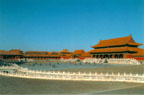 Beijing , China 's capital for the past 700 years offers a tremendous concentration of ancient and historic artifacts and edifices from her 2000 years of history. The spectacular 500-year-old Forbidden City, the home of the emperors of Qing Dynasty, with over nine thousand rooms, is a collection of treasures; the massive Tian-an-men Square locates in the very center of the city; the delicately crafted Temple of Heaven provides an exquisite example of Feng shui; the Summer Palace is a lovely remnant from the days of the deliciously infamous Empress Dowager, Cixi. And, of course, there is the Great Wall. Built between 15 century B.C. and 16 century A.D., this 6300 kilometer long extends from China's east coast, thousands of miles to the country's center, trickling into the desert sands of Gansu Province. Beijing , China 's capital for the past 700 years offers a tremendous concentration of ancient and historic artifacts and edifices from her 2000 years of history. The spectacular 500-year-old Forbidden City, the home of the emperors of Qing Dynasty, with over nine thousand rooms, is a collection of treasures; the massive Tian-an-men Square locates in the very center of the city; the delicately crafted Temple of Heaven provides an exquisite example of Feng shui; the Summer Palace is a lovely remnant from the days of the deliciously infamous Empress Dowager, Cixi. And, of course, there is the Great Wall. Built between 15 century B.C. and 16 century A.D., this 6300 kilometer long extends from China's east coast, thousands of miles to the country's center, trickling into the desert sands of Gansu Province.
As the embodiment of traditional China , dazzling with ancient culture, the fabled City of Beijing is a "must go" place for travelers from the whole world.
Shanghai
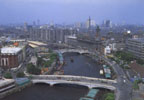 Teeming with life, Shanghai is the most cosmopolitan and largest city in China. With a population of 13 million, Shanghai generates over one eighth of the Gross National Product. Its name means "on the sea", and it is located on the coast of the East China Sea and famous Yangtze River. Its origins can be traced back to a small isolated fishing village that grew up around the 8th century during the Song Dynasty. After the Opium War in 1840, the city was forced to grant Western merchants permission to trade and lease land on the west bank of the Huangpu River. From then on, Shanghai rapidly made a name for itself as a leading trading center in the East. Teeming with life, Shanghai is the most cosmopolitan and largest city in China. With a population of 13 million, Shanghai generates over one eighth of the Gross National Product. Its name means "on the sea", and it is located on the coast of the East China Sea and famous Yangtze River. Its origins can be traced back to a small isolated fishing village that grew up around the 8th century during the Song Dynasty. After the Opium War in 1840, the city was forced to grant Western merchants permission to trade and lease land on the west bank of the Huangpu River. From then on, Shanghai rapidly made a name for itself as a leading trading center in the East.
A walk through Shanghai's neighborhoods reveals a surprising mix of European architecture and old and new Chinese facades. There are streets of shops selling articles of Chinese art, antiques and curios. Amongst them Nanjing road is the busiest one. Other tourist attractions include the Mandarin's Garden, the Jade Buddha Temple, Shanghai Museum, and the Oriental Pearl TV Tower.
Xian
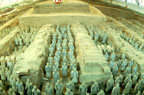 Xian was the capital of eleven dynasties from the 11 th century B.C. to the 10 th century A.D. and has been pivotal throughout China 's history. Xian and its history most vividly exemplify the extroaordinary continuity of Chinese civilization. Xian was the capital of eleven dynasties from the 11 th century B.C. to the 10 th century A.D. and has been pivotal throughout China 's history. Xian and its history most vividly exemplify the extroaordinary continuity of Chinese civilization.
The city's great claim to fame in modern times, however, is the legendary league of more than 6000 terracotta warriors and horses that stood guard over Emperor Qin Shi Huang's tomb for two thousand years. Nearby are the remains of an 8000-year-old Ban Po Village. East of Xian lies the Hua Qing Hot Springs, an oasis of lush greenery and red-roofed pavilions where, in 1936, Chiang Kai-shek was captured by his own troops and forced to negotiate with Mao Zedong.
Xian has become one of the most popular tourist destinations since the discovery of terracotta figures.
Suzhou (not included in 2009 trip)
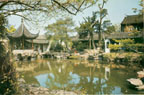 Suzhou is known as the " Venice of the East". It is a 45-minute train ride from Shanghai and located south of the Yangtze River delta. The city sits on a network of waterways, connecting into the Grand Canal , the longest man-made Grand Canal in the world - 800 miles which was originally constructed to bear tribute rice from the Yangtze Plain to the imperial government in Beijing . Suzhou is known as the " Venice of the East". It is a 45-minute train ride from Shanghai and located south of the Yangtze River delta. The city sits on a network of waterways, connecting into the Grand Canal , the longest man-made Grand Canal in the world - 800 miles which was originally constructed to bear tribute rice from the Yangtze Plain to the imperial government in Beijing .
Suzhou is famous for its gardens -- "The best gardens are in the south; the best southern gardens are in Suzhou ." They are rare examples of classical Chinese gardening -- elegant, unique, refined and unadorned. Suzhou , together with Hangzhou , is known as the " Paradise on Earth".
Suzhou is also well-known for its beautiful silk embroidery.
Guilin (not included in 2009 trip)
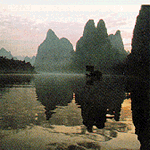 Guilin with subtropical climate is situated in the northeastern corner of Guangxi Autonomous Region. In prehistoric times, the area was a wide extend of sea. The karst landscape was created by the erosion of limestone surface, forming steep, isolated hills, caverns and underground channels. Guilin with subtropical climate is situated in the northeastern corner of Guangxi Autonomous Region. In prehistoric times, the area was a wide extend of sea. The karst landscape was created by the erosion of limestone surface, forming steep, isolated hills, caverns and underground channels.
One can enjoy the beautiful scenery from the peak of Piled Festoon Hill or on a boat trip downstream to Yangzhou along the Li River from Guilin .
Equally remarkable are the caves there, such as Reed Flute Cave or Seven-star cave. The unusual beauty of stalactite and stalagmite formations rivals that of the scenery outside the caves.
The Elephant Trunk Hill is nature's work of art. The scenery of Guilin is nature's poetry beyond any attempts of description.
Chongqing
 Chongqing is the 4 th Municipality city in China . Located in the Sichuan Basin , it's nicknamed Hill City or Foggy City . The population is around 23 millions. This city used to be the temporary capital for the Kuo Min Tang Government. Chongqing is the 4 th Municipality city in China . Located in the Sichuan Basin , it's nicknamed Hill City or Foggy City . The population is around 23 millions. This city used to be the temporary capital for the Kuo Min Tang Government.
Yangtze River Cruise (Three Gorges)
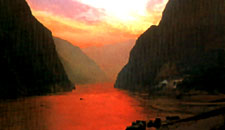 On board the deluxe cruise and sailing down the Yangtze River , passing through the breath-taking Three Gorges with deep zigzagging valley, forested mountains, churning water cloistered by towering moss-clad precipices. Transfer to motorboats to cruise up the awe-inspiring Three Little Gorges with boat trackers. Then arrive Gezhouba Dam and pass through one of the largest locks in the world. On board the deluxe cruise and sailing down the Yangtze River , passing through the breath-taking Three Gorges with deep zigzagging valley, forested mountains, churning water cloistered by towering moss-clad precipices. Transfer to motorboats to cruise up the awe-inspiring Three Little Gorges with boat trackers. Then arrive Gezhouba Dam and pass through one of the largest locks in the world.
|




 ::
:: ::
::  ::
::  ::
::